How Atmospheric Water Generation Actually Works?
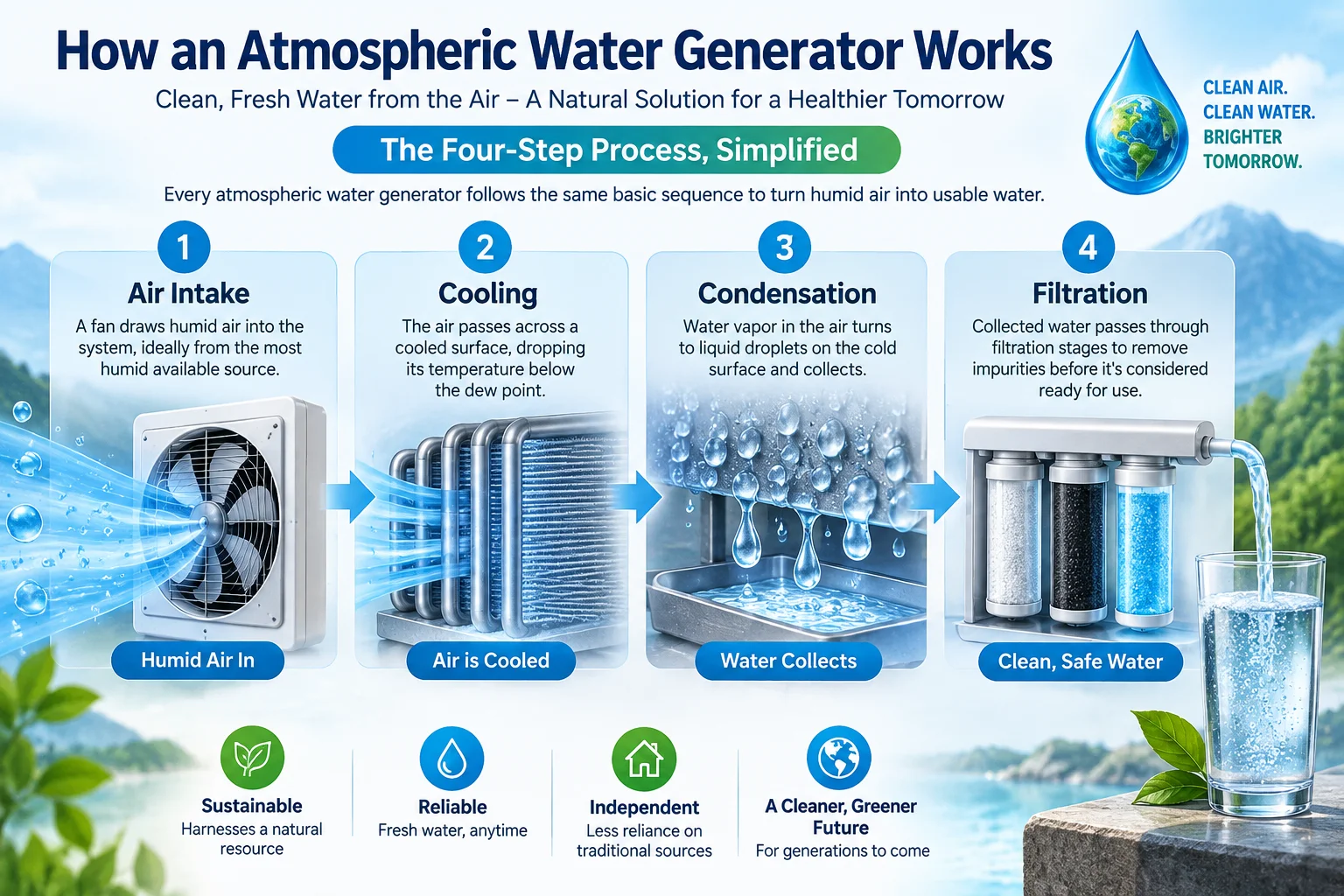
Atmospheric water generation, often shortened to AWG, is the process — used by guides like Water Freedom System — of pulling water vapor that's already present in the surrounding air and converting it into liquid water through condensation. It isn't a new or experimental idea — it's the same basic physics behind the puddle that collects under a running air conditioner, or the droplets that form on a cold glass of water on a humid day. AWG technology simply takes that naturally occurring process and controls it deliberately, so the resulting water can be collected, filtered, and used.
The technology scales from small household or DIY units all the way up to large industrial systems that supply drinking water in arid regions and disaster-relief situations. The underlying science is identical at every scale — what changes is the size of the cooling surface, the volume of air processed, and the amount of energy required.
Every atmospheric water generator, regardless of size, follows the same basic sequence to turn humid air into usable water.
A fan draws humid air into the system, ideally from the most humid available source.
The air passes across a cooled surface, dropping its temperature below the dew point.
Water vapor in the air turns to liquid droplets on that cold surface and collects.
Collected water passes through filtration stages before it's considered ready for use.
Dew point is the single most important concept behind atmospheric water generation. It's the temperature at which air becomes fully saturated with moisture and can no longer hold that water vapor as a gas — at that point, the excess moisture is forced to condense into liquid. Every parcel of air has a dew point that depends on how much moisture it's already carrying: humid air has a relatively high dew point, while dry air has a much lower one.
This is why cooling humid air even a small amount can trigger significant condensation, while cooling dry air by the same amount may produce almost nothing — there simply isn't much moisture available to begin with. This single relationship explains most of what determines how well an atmospheric water generator performs in any given location.
Atmospheric water generation performance isn't fixed — it shifts constantly based on environmental and equipment conditions. These four factors matter most.
The single biggest factor. More moisture already in the air means more available to condense once cooled — and less humidity means output drops sharply.
Warmer air can hold more water vapor before reaching its dew point, so warm, humid conditions generally outperform cool, dry ones.
Air needs to move across the cooling surface at a steady, balanced rate — too weak and moisture-laden air never reaches the coil, too strong and it doesn't cool enough to condense.
A larger, cleaner, more efficient cooling surface can process more air and extract more moisture in the same amount of time.
| Humidity Level | General Effect on Output |
|---|---|
| High humidity (humid, coastal, tropical climates) | More consistent, higher potential output |
| Moderate humidity (mixed seasonal climates) | Output varies meaningfully with the seasons |
| Low humidity (arid, desert regions) | Output drops sharply and can become unreliable |
Condensed water isn't automatically safe to drink the moment it forms — collection and filtration matter just as much as the condensation process itself. Once droplets form on the cooling surface, they typically flow down into a collection tray, then through tubing into a storage reservoir.
From there, a filtration stack is what actually makes the water usable — see our full breakdown of whether this water is actually safe to drink. A common baseline approach uses sediment filtration first (removing dust and particulates), followed by activated carbon (improving taste and odor and reducing certain chemicals), with ultraviolet (UV) sterilization sometimes added as a final step to address microorganisms. Without proper filtration and clean handling, condensed water can pick up contamination from the collection surfaces themselves — which is why the treatment stage of any atmospheric water generator matters just as much as how well it condenses moisture in the first place.
Functionally, yes — the core mechanism is nearly identical. A household dehumidifier pulls in humid air, cools it below its dew point, and collects the resulting condensate, mainly to reduce indoor humidity. An atmospheric water generator uses that same basic process, but the goal and the downstream handling are different: the collected water is treated as a resource to be filtered, purified, and made safe to drink, rather than simply drained away.
This is a useful mental shortcut if you've ever emptied a dehumidifier's water tank — you've already seen atmospheric water generation happen firsthand, just without the filtration steps that would make that water suitable to drink.
Curious how this science translates into an actual DIY build?
See the Full GuideNow that you understand the science, the Water Freedom System guide walks through how to translate this exact process into a DIY build using everyday hardware components.
Explore the Guide